
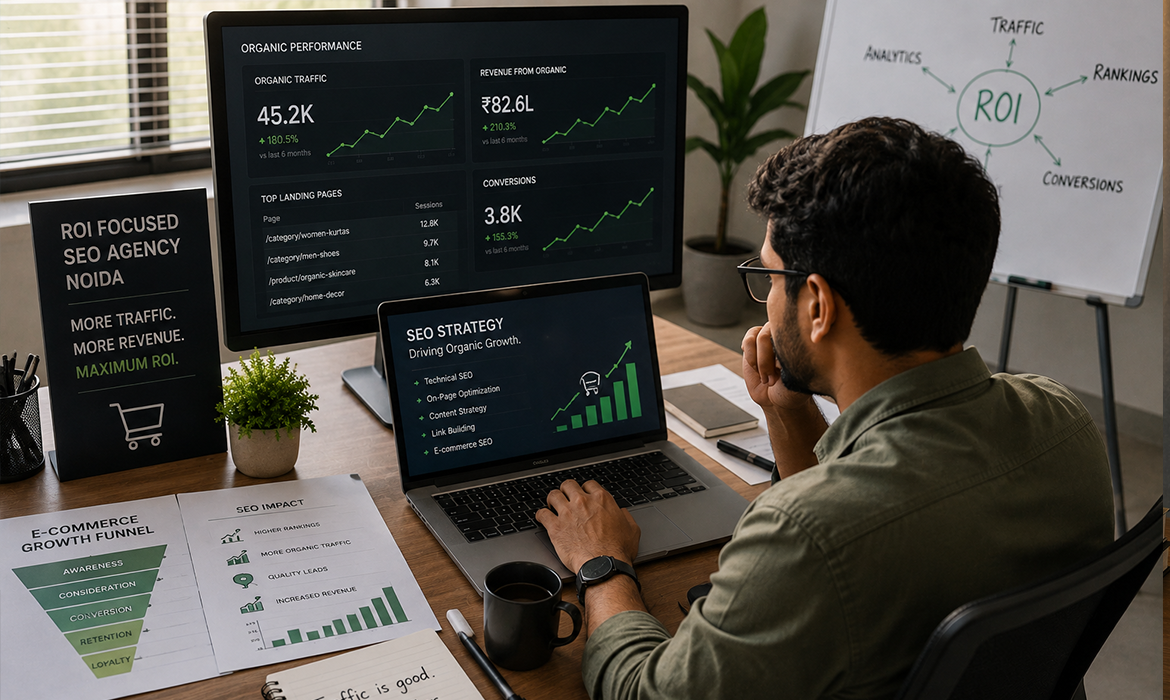
Nearly every SEO agency in Noida claims to be “ROI-focused.” You’ve seen the pitches—”1000% ROAS!” or “triple your revenue in 90 days!”—with zero baseline shown and no methodology visible. For e-commerce brands tired of vanity metrics dressed up as results, this post defines what ROI-focused SEO should actually mean, how to measure it properly, and what questions separate real practitioners from performance theater.
When every agency uses the same language, the term loses value. Real ROI focus for e-commerce means tying every SEO task—keyword research, product page optimization, technical fixes—to measurable revenue outcomes, not traffic volume or ranking position. It means showing the baseline, not just the percentage lift. And it means platform-specific work for large catalogs, not generic blog SEO rebranded for online stores.
E-commerce SEO performance lives at the category and product level. Site-wide traffic growth means nothing if your profitable categories aren’t moving. Real measurement tracks organic revenue by product line, not aggregate sessions.
You can rank #1 for a keyword with zero buying intent and generate nothing. E-commerce SEO demands intent-based targeting—ranking for terms that convert, not terms that impress in reports. For a complete breakdown of how product-focused optimization differs from content SEO, see our Ecommerce SEO approach.
Reports should show revenue attribution by category and product, not just sessions or impressions. Which product lines are growing organically? Which categories need more work? That’s the data that drives decisions.
SEO rarely closes a sale alone. A customer discovers your product organically, returns via direct traffic, and converts. Assisted conversions show SEO’s true contribution across the funnel—ignoring them undervalues the channel entirely.
How does organic CAC compare to paid search or social? Over six months? Twelve? That comparison reveals SEO’s compounding value and justifies continued investment beyond short-term wins.
Ask for organic revenue data, not position reports. If they can’t show it, they’re not measuring what matters.
Multi-channel attribution is complex, but any agency claiming ROI focus should have a clear methodology for isolating organic impact.
E-commerce sites with thousands of SKUs face technical challenges generic SEO doesn’t address. Catalog-scale optimization is a different discipline entirely.
Percentages without baselines are marketing, not measurement. Ask for before-and-after numbers with context.
If an agency won’t show the starting point, the percentage is meaningless. Tripling revenue from ₹10,000 to ₹30,000 is very different from ₹10 lakh to ₹30 lakh.
If monthly reports feature keyword positions and organic sessions but never revenue or conversions, the agency isn’t tracking what you actually care about.
Each platform has unique technical requirements. Vague “we handle all e-commerce platforms” claims usually mean shallow experience across all of them.
Your money pages are categories and products, not blog posts. Optimizing them for search intent and conversion is where revenue lives.
Faceted navigation, filter parameters, and crawl budget management are non-negotiable for catalogs over 500 SKUs. Miss these, and Google never sees your best products.
Schema markup for products, reviews, pricing, and availability directly impacts visibility in search results. It’s not optional for competitive e-commerce SEO—explore our full SEO services for implementation details.
Noida and NCR markets demand localized trust signals, faster delivery messaging, and regional keyword variations. A local SEO agency in Noida understands these nuances instinctively—national agencies often miss them entirely.
At Clickseek Digital, e-commerce reports show organic revenue by category and assisted conversions from day one. Revenue data isn’t something you request separately—it’s the foundation of every report.
We present before-and-after numbers together, with context. No isolated percentage lifts without the starting point. If we can’t show the baseline, we don’t make the claim.
Crawl budget management, category page structure, and faceted navigation handling are baseline scope for e-commerce clients—not premium upsells layered on top of a generic package.
We work specifically with Shopify, WooCommerce, and Magento stores. Each platform gets a tailored technical approach, not a one-size-fits-all checklist.
It means every SEO task ties to measurable revenue outcomes—organic sales by category, assisted conversions, and CAC compared against paid channels. Not rankings or traffic alone.
Expect 3–6 months for meaningful revenue impact. Technical fixes and quick wins can show earlier, but sustained category-level growth takes consistent effort.
Ask for revenue-attributed data with baselines shown. Ask how they separate organic impact from other channels. Ask for platform-specific process details. Vague answers are red flags.
Completely. E-commerce SEO focuses on product and category pages, handles catalog-scale technical challenges, and measures success in revenue and conversions—not traffic or rankings.

Bangalore, India
