
Table of Contents
- The Problem With an Ads-Only Lead Generation Strategy
- What “Full-Funnel” Actually Means for Enterprise Lead Generation
- Why This Shift Is Happening Now Among Indian Enterprises
- Ads vs. Full-Funnel Agency Partnerships: A Direct Comparison
- What to Look for in a Full-Funnel Enterprise Lead Generation Partner
- Making the Shift Without Disrupting Current Pipeline
- Making the Move
- Where This Fits in the Wider Indian Market
- FAQs

Marketing heads at large Indian enterprises are rewriting their media plans. Ad budgets that once went almost entirely to Google Ads and LinkedIn campaigns are getting split, with a growing share moving toward agencies that handle the full buyer journey instead of just the click.
Few enterprises are dropping paid media altogether. What’s changing is the split, and a few things are behind it:
- Cost per click has climbed faster than pipeline value
- Boards want spend justified in revenue terms, not impressions
- Buyers are doing far more research before a sales rep ever hears from them
The Problem With an Ads-Only Lead Generation Strategy
Rising CAC and diminishing paid returns
Customer acquisition cost on paid channels has gone up steadily across most B2B categories in India, especially on LinkedIn Ads, where competition for enterprise decision-makers is dense.
- Teams running the same campaigns as two years ago often pay more for the same or fewer qualified leads
- When CAC rises faster than deal value, an ads-only budget stops making sense on its own
Ads generate clicks, not qualified enterprise pipeline
A click tells you someone was curious enough to tap a button. It doesn’t tell you:
- Whether that person has budget authority
- Whether their company fits your ideal customer profile
- Whether they’re anywhere close to a buying decision
Enterprise sales cycles in India often run six to eighteen months and involve multiple stakeholders. Paid ads alone rarely carry a lead through that many stages of scrutiny, so sales teams end up chasing volume instead of qualified opportunities.
No compounding value: spend stops, leads stop
The bigger issue with an ads-only approach is what’s missing when the campaign ends.
- Campaign budget pauses, lead flow pauses with it
- No ranking content left over
- No nurtured database working quietly in the background
- No organic visibility carried into the next quarter
What “Full-Funnel” Actually Means for Enterprise Lead Generation
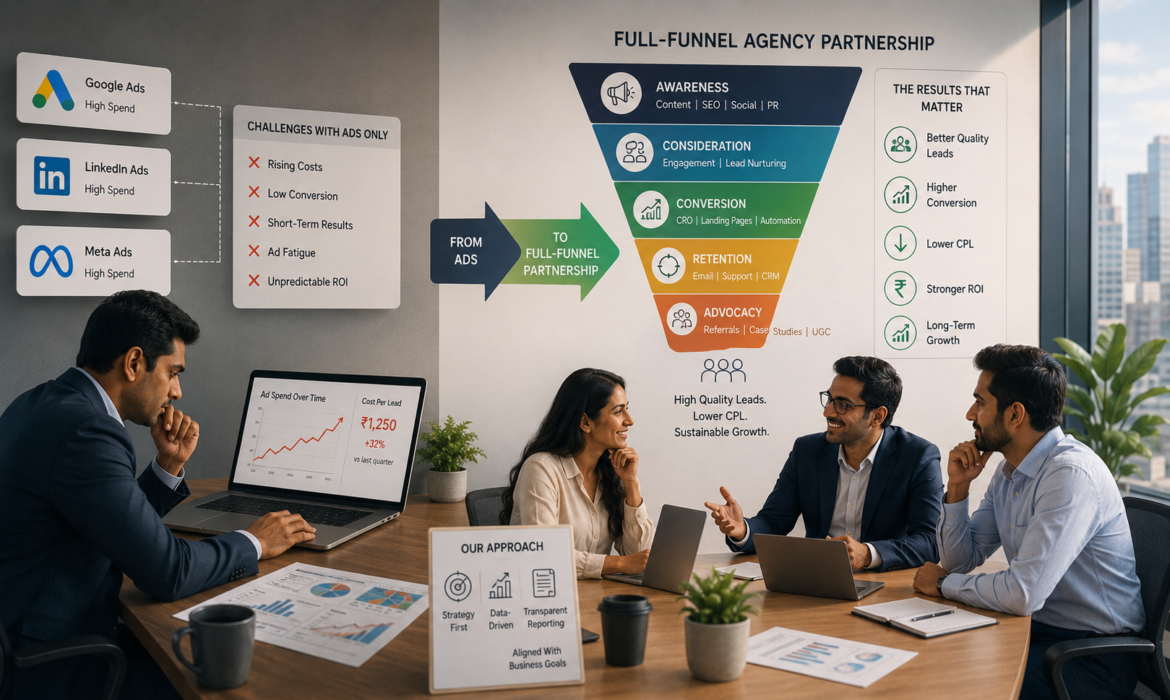
TOFU, MOFU, BOFU: how each stage is covered
A full-funnel lead generation strategy maps content and outreach to where a buyer actually is:
- Top of funnel: SEO content and thought leadership build awareness among people who aren’t yet searching for a vendor
- Middle of funnel: Comparison content, case studies, and retargeting help prospects evaluate whether your company solves their problem
- Bottom of funnel: Sales enablement material, personalised outreach, and account-based campaigns help close deals that are already warm
Paid ads can sit inside this model too, as one channel among several, rather than the entire strategy.
SEO, content, retargeting, and sales enablement working together
Full-funnel agencies run SEO, content marketing, retargeting, and sales enablement as one connected effort instead of separate line items. For example, a prospect might:
- Discover a blog post through organic search
- See a retargeting ad a few days later
- Get an industry-relevant case study from the sales team
Each touchpoint builds on the last instead of starting the relationship over.
Why this holds up over time instead of resetting monthly
Content and SEO behave differently from paid media:
- A well-optimised page keeps generating traffic and leads long after it’s published
- A nurtured contact database keeps producing opportunities even when ad spend pauses
- Work put in during month one is still paying off in month twelve, unlike ad spend, which has to be renewed each month to keep producing results
Why This Shift Is Happening Now Among Indian Enterprises
Longer, more complex B2B sales cycles
Enterprise buying committees in India have grown. A single deal might involve:
- A procurement team
- An IT security review
- A finance sign-off
- Multiple business stakeholders, each entering the conversation at a different point
A single ad click can’t account for that complexity. Marketing has to support the buyer across a longer, more crowded decision path than a click can cover.
Increased scrutiny on marketing ROI from leadership and boards
CFOs and boards are asking sharper questions than before:
- How many leads came in
- How many of those turned into pipeline
- How many of those became closed revenue
A B2B demand generation agency built around pipeline and revenue reporting can answer these directly. An ads-only setup, measured mainly in clicks and cost per lead, usually can’t.
Buyer behaviour changes: more research before contact
Enterprise buyers in India now research vendors extensively before filling out a form or replying to a sales email:
- Reading comparison articles
- Checking case studies
- Browsing review sites
- Asking peers for recommendations
Much of this evaluation happens before a salesperson gets involved. An enterprise digital marketing strategy that only shows up at the ad-click moment misses that research phase almost entirely. SEO and content are what get found during it.
Ads vs. Full-Funnel Agency Partnerships: A Direct Comparison
| Factor | Paid Ads Only | Full-Funnel Agency Partnership |
| Cost predictability | Costs rise with competition and auction pressure; budgets need constant adjustment | More stable over time as organic channels reduce dependence on auction pricing |
| Lead quality | High volume of clicks, mixed intent and fit | Leads filtered through content and stages, closer to sales-ready |
| Scalability | Scaling means spending more, with diminishing returns past a point | Scales through compounding content and nurtured audiences, not just budget increases |
| Time to first results | Fast, often within days of launching a campaign | Slower initial ramp, typically 3 to 6 months for SEO and content to gain traction |
| Long-term asset value | None once spend stops | Content, rankings, and database keep producing leads independent of active spend |
Paid ads still deliver the fastest initial results. That’s the main reason most agencies recommend running both in parallel during a transition rather than switching all at once.
What to Look for in a Full-Funnel Enterprise Lead Generation Partner
Integrated strategy across channels, not siloed services
Many agencies offer SEO, ads, and content as separate services with separate teams and reports. A partner actually running full-funnel work will show this instead:
- Keyword research from SEO informs the ad copy
- Leads from ads feed into the same nurture sequence as organic leads
- Content, retargeting, and sales enablement pull from the same data
If an agency can’t explain how its channels talk to each other, they’re likely running silos with a shared invoice.
Reporting tied to pipeline and revenue, not just impressions
Ask any prospective partner how they report results. Watch for whether they stop at:
- Impressions
- Clicks
- Cost per lead
A B2B lead generation partner built for enterprise accounts should tie activity back to sales-qualified leads, pipeline value, and closed revenue, ideally through CRM integration.
Making the Shift Without Disrupting Current Pipeline
Transitioning budget gradually
Cutting paid spend abruptly creates a gap: leads from ads slow down before SEO and content have had time to build momentum. A gradual shift works better:
- Move a portion of the ad budget each quarter
- Let content and SEO ramp up in parallel
- Protect pipeline continuity throughout the transition
Running ads and full-funnel in parallel during handoff
For most enterprises, the safest path is running both approaches side by side for a defined period, often two to three quarters:
- Ads keep the pipeline flowing in the short term
- SEO, content, and nurture sequences build toward a self-sustaining lead source
- Once full-funnel channels produce consistent qualified leads, ad spend can be scaled back or redirected to specific campaigns
What to measure in the first 90 days
The first quarter is unlikely to show major traffic or ranking gains, since SEO and content take time to mature. Early indicators to track instead:
- Quality of the content and keyword strategy being built
- Accuracy of ICP and persona definitions
- Initial engagement on published content
- Whether reporting connects activity to pipeline stages from day one
Making the Move
Most enterprises won’t have to pick one model over the other. Ads can keep pipeline flowing while content, SEO, and nurture sequences build up alongside them, so lead flow doesn’t drop the moment a campaign budget pauses.
For marketing leaders working out how to allocate budget for enterprise lead generation this year, a useful starting point is:
- Review current channel performance
- Map where the funnel has gaps
- Test a full-funnel approach alongside existing ad spend before committing more budget
If you’re weighing this shift for your own marketing plan, a custom growth strategy assessment is a low-risk way to see where full-funnel would fit alongside what’s already working.
Where This Fits in the Wider Indian Market
This isn’t happening in isolation. India’s digital ad market is projected to keep growing at double-digit rates through 2026, and B2B digital ad spend in India is among the fastest-growing anywhere globally. Costs are climbing alongside that growth, which is part of why more budget is going a different way.
Industry benchmarks for established Indian B2B brands now show content and SEO taking the largest single share of the digital marketing budget, ahead of paid media, with martech and other channels splitting the rest. That budget split lines up with what’s covered above: enterprises are funding the channels that keep working after the campaign ends, not just the ones that produce the fastest click.
For a company like ClickSeek Digital, working across sectors from D2C to enterprise edtech and B2B SaaS, this pattern shows up consistently. Clients that started with an ads-heavy setup and added SEO, content, and structured reporting alongside it tend to see steadier lead flow than those relying on ad spend alone.
FAQs
- Is a full-funnel strategy more expensive than running paid ads?
Not always. SEO and content usually cost more upfront. Ad spend keeps recurring every month, while content and rankings keep working once they’re built. Over 12 to 18 months, the totals for both approaches often land close to each other. - How long does it take to see results from a full-funnel approach?
Paid ads can produce leads within days. SEO and content usually take three to six months to gain real traction. Most agencies run both channels together during that ramp-up period instead of pausing ads early. - Should we stop paid ads completely when switching to full-funnel?
No. Cutting ad spend abruptly usually creates a lead gap before organic channels are ready to fill it. A phased shift, moving a portion of budget each quarter, protects pipeline while the new channels build up. - What size of enterprise actually needs a full-funnel agency partner?
Enterprises with long sales cycles, several stakeholders in the buying decision, and larger deal values tend to see the most value. A single ad click rarely carries a lead through that much scrutiny on its own. - How do we know if an agency is actually running full-funnel work and not just bundling services?
Ask how their channels connect. Does SEO keyword data inform ad targeting? Do ad leads and organic leads flow into the same nurture sequence? Does reporting tie back to pipeline and revenue, not just clicks or impressions? - What should we track in the first few months of a full-funnel engagement?
Traffic and lead volume take time to build. Early on, look at the quality of the content and keyword strategy, how accurately the ICP and buyer personas are defined, and whether reporting already connects to pipeline stages.