
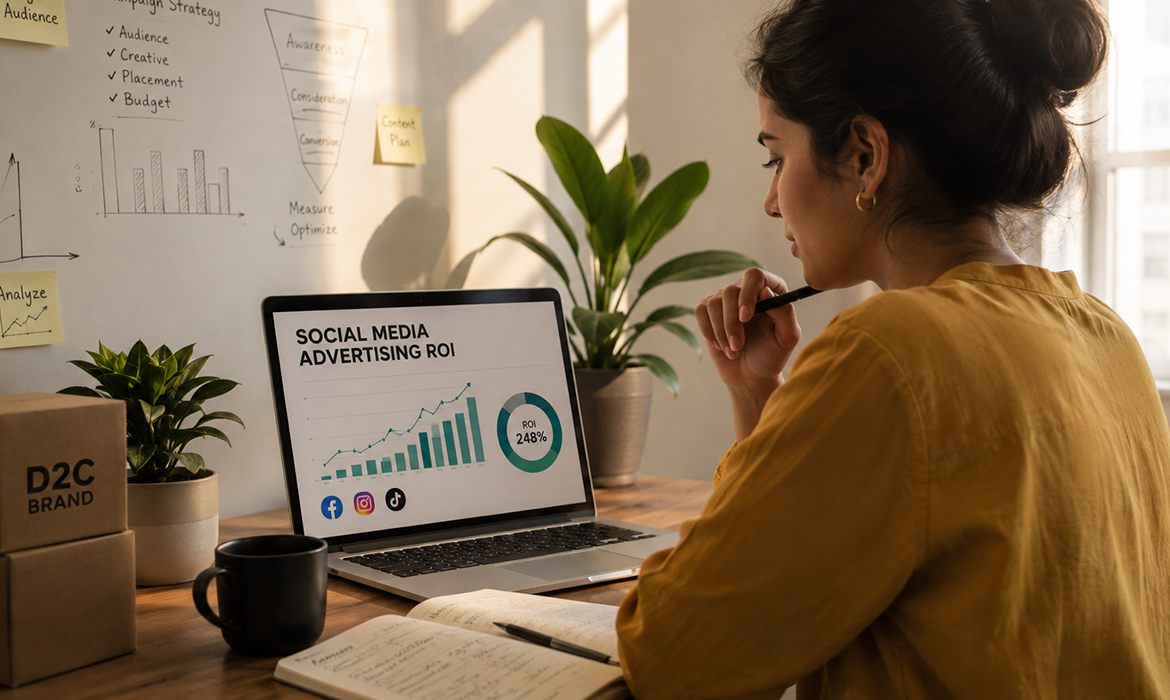
Marketers obsess over which platform delivers the “best ROI.” Meta versus YouTube. Instagram versus Pinterest. But here’s what the data actually shows: execution determines returns far more than the platform itself. Creative quality, full-funnel strategy, and targeting precision drive performance. A well-executed social media advertising campaign on any platform beats a mediocre one on the “best” platform every time. Platform doesn’t save bad creative. Focus on execution first, platform optimization second. This principle applies whether you’re running campaigns on Meta, YouTube, or LinkedIn—superior execution wins regardless of channel.
For most D2C brands with 30-50% margins, a 2.5x to 4x first-purchase ROAS keeps you profitable after factoring in product costs, shipping, and overhead. Skincare and wellness brands with higher margins can aim for 4x to 6x. The key? Know your actual profit per sale before setting targets.
First-purchase ROAS alone ignores customer lifetime value. A customer acquired at break-even who repurchases three times over six months? That’s a winning campaign. This is why tracking LTV alongside CAC is non-negotiable.
Platform doesn’t save bad creative. A compelling hook, clear value proposition, and strong call-to-action will outperform generic content regardless of where it runs. Focus on execution first, platform optimization second.
Recycling the same asset across Meta, YouTube, and Pinterest kills performance. Each platform has distinct content formats and user expectations. Instagram demands visually compelling content. YouTube rewards storytelling through longer-form video. Meta excels with both short-form and carousel formats. Adapt your creative accordingly.
User-generated content and influencer whitelisting consistently outperform branded content. Meta’s branded content tools and YouTube’s influencer partnerships let you amplify authentic creator posts with paid budget—combining organic credibility with paid reach.
Despite privacy changes, Meta remains the conversion workhorse for D2C. Its pixel tracking, lookalike audiences, and retargeting capabilities still deliver the highest purchase intent traffic for most brands.
YouTube excels at product education and building trust through longer-form content. It’s particularly effective for products requiring explanation or demonstration. Test YouTube for mid-funnel audiences who need more convincing before purchase.
Every quarter brings a new “must-be-on” platform. But spreading budget thin across five channels gets you nothing on any of them. Master one platform where your buyers actually are before expanding.
Without proper UTM tracking and conversion pixels, you’re flying blind. Multi-touch attribution shows which touchpoints drive conversions—not just the last click. This visibility is essential for optimizing spend allocation.
Blended ROAS hides underperforming channels. Track CAC separately for Meta, YouTube, and Google to identify where your money actually works. At Clickseek Digital, we break down performance by channel from day one so you know exactly what’s driving profit.
With iOS privacy changes limiting pixel tracking, first-party data—email lists, customer databases, website behavior—is now your most valuable targeting asset. Build your owned audience aggressively.
Retargeting delivers significantly higher ROAS than cold prospecting. Cart abandoners, product page viewers, and past customers already know your brand. They just need the right nudge—a discount, social proof, or urgency trigger.
Paid social acquires the customer. A strategic email marketing campaign captures their lifetime value. This combination is where real ROI multiplies—not from either channel alone.
Automated email flows recover abandoned carts and drive repeat purchases without additional ad spend. These flows directly boost the ROI of your social media advertising campaign by maximizing revenue from each acquired customer.
Evaluating paid social without considering email retention and repeat purchase rates undersells its true value. A customer acquired at 2x first-purchase ROAS who generates substantial total revenue through email-driven repurchases? That’s a winning acquisition channel.
Most D2C brands allocate 40-60% of digital marketing budget to social advertising, with the remainder split between search, email, and content. High-growth brands skew higher during scaling phases.
Platform performance fluctuates. Brands that can reallocate budget within 48 hours based on real-time CAC and ROAS data consistently outperform those locked into monthly plans. Build agility into your approval processes.
New campaigns need data to optimize. The first 2-4 weeks often run at break-even or slight loss while algorithms learn and you gather conversion data. This is normal—not a failure signal.
Real performance becomes clear after 90 days, once you’ve tested creative variations, refined audiences, and captured repeat purchase data. Judging campaigns at 30 days misses the compounding effect of LTV.
We establish margin-based ROAS targets with clients upfront—not generic industry numbers. Performance gets judged against what’s realistic for your specific business model, product margins, and customer behavior.
We produce distinct creative for each platform rather than recycling one asset across Meta, YouTube, and Pinterest. Platform-native creative consistently delivers superior performance compared to repurposed content.
We test platform fit against actual buyer behavior and early campaign data—not whichever platform is trending. This data-driven approach prevents wasted spend on mismatched channels.
Our standard reporting breaks out CAC and ROAS per channel, not one blended number. You see exactly which platforms drive profitable growth and which need optimization or pause.
We connect paid social retargeting audiences with email flows—abandoned cart, post-purchase, win-back—so you see ROI as a combined acquisition-plus-retention picture. This integrated approach, combining social advertising with a well-executed email marketing campaign, is where real profit multiplies.
A good first-purchase ROAS for D2C brands typically ranges from 2.5x to 4x, depending on your margins. Brands with higher margins (50%+) should target 4x to 6x. However, true ROI must factor in customer lifetime value, not just first purchase.
Meta (Facebook and Instagram) consistently delivers the highest ROI for most D2C brands due to superior conversion tracking and retargeting capabilities. However, execution quality—creative, targeting, funnel strategy—matters more than platform choice alone.
Email marketing captures lifetime value from customers paid social acquires. Automated flows like abandoned cart recovery and post-purchase sequences boost overall campaign ROI by maximizing revenue per acquired customer without additional ad spend.
Most campaigns need 2-4 weeks to exit the learning phase and 90 days to show true performance including repeat purchases. Early-stage campaigns often run at break-even while gathering optimization data. Judge real ROI after a full quarter, not at 30 days.

Bangalore, India
