
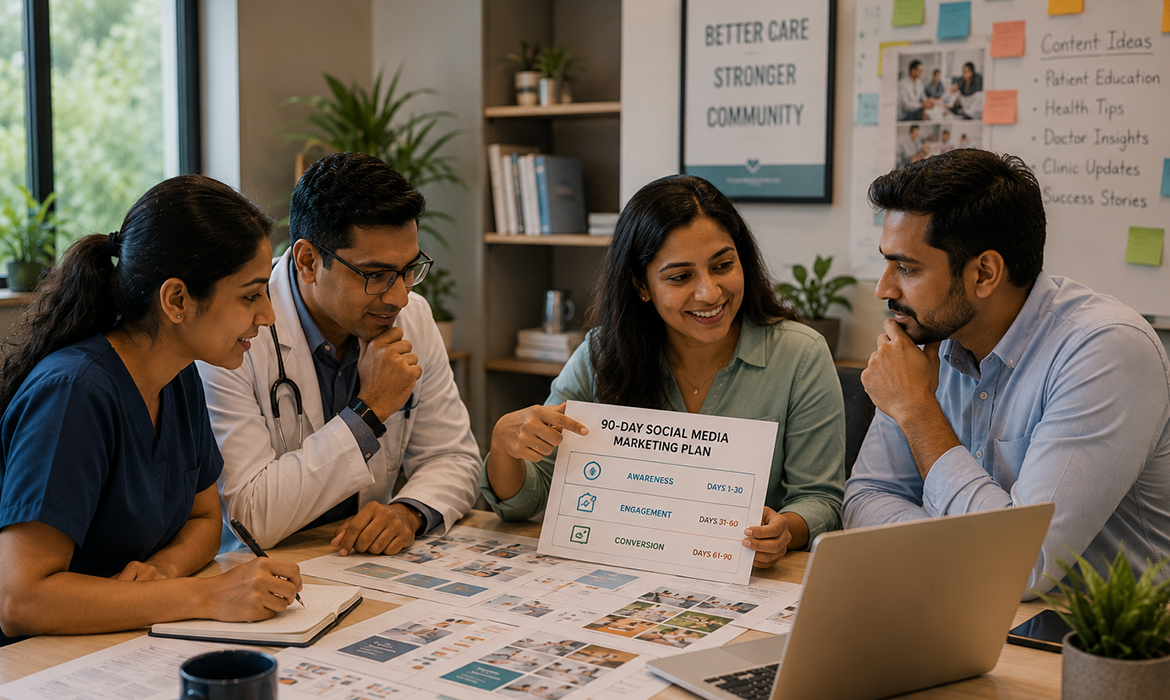
Most hospitals in India post on Instagram five times a week and still can’t figure out why the phone isn’t ringing. Here’s the truth: healthcare social media marketing isn’t about more posts. It’s about compliant, trust-building content with a booking path under three clicks. Just as hospitals invest in healthcare SEO services to capture patients searching for solutions, your social strategy must convert followers into appointments. Before you even start, you need the right digital foundation—just like choosing the right website development partner matters for your online presence, picking the right approach to social media determines whether followers become patients. This 90-day playbook shows you exactly what to do, week by week, to turn followers into patients walking through your door.
When someone searches for a hospital, they’re not shopping for shoes. They’re looking for credibility, expertise, and safety. Your social presence must answer “Can I trust this facility?” before “What services do you offer?” That’s the fundamental difference between healthcare social media marketing and every other industry.
Healthcare marketing in India operates under strict regulations that most digital agencies completely ignore. The NMC regulations, ASCI guidelines, and the Drugs and Magic Remedies Act aren’t suggestions—they’re legal requirements that can shut down your campaigns or worse.
The National Medical Commission’s 2023 regulations prohibit solicitation and self-promotion by doctors. That Instagram Reel celebrating your “best surgeon” or “100% success rate”? It violates NMC guidelines. Understanding these boundaries before you post isn’t optional.
The Advertising Standards Council of India restricts health claims, while the Drugs and Magic Remedies Act prohibits advertising cures for specific conditions. Your “guaranteed results” post could trigger legal action. Frame claims carefully, focusing on education rather than promises.
Sharing patient testimonials or before-after photos without proper consent violates the Digital Personal Data Protection Act. Every piece of patient-related content needs documented consent and careful anonymization where required.
Strike these from your vocabulary: “guaranteed outcomes,” “best,” “number one,” specific success rates, “cure,” and comparative claims against competitors. This isn’t legal advice—always run your content calendar past a healthcare compliance expert before publishing. For hospitals serious about compliant digital marketing, specialized healthcare marketing agencies build compliance into the workflow, not bolt it on afterward.
Screenshot every post, story, and bio across your profiles. Flag anything that violates NMC or ASCI guidelines. Then audit three competitors: What are they posting? Where are they getting engagement? What compliance mistakes are they making that you can avoid?
Healthcare audiences aren’t monolithic. You’re speaking to patients seeking treatment, caregivers researching options, and referring doctors evaluating your expertise. Each segment needs different content. Map which platforms serve which audience best.
Start with your Google Business Profile—it’s the highest-ROI channel for local clinics. Hospitals with 100+ reviews and 4.5+ ratings dominate Maps searches. Then set up one social platform: Instagram for aesthetic specialties (derm, dental, IVF), Facebook for tier-2 and tier-3 cities, LinkedIn for B2B referrals.
No post goes live without passing through compliance review. Create a three-step workflow: draft, compliance check against NMC/ASCI guidelines, approval. This isn’t bureaucracy—it’s protection. One non-compliant post can trigger regulatory action that costs more than your entire annual marketing budget.
Structure your content around four pillars: Education (symptom awareness, prevention tips), Facility/Team (introducing doctors, showcasing infrastructure), Patient Experience (compliant testimonials, journey stories), and Preventive Health (seasonal health tips, wellness advice). This mix builds trust while staying compliant.
Doctor-fronted content dramatically increases trust and engagement. But forcing uncomfortable doctors on camera backfires. Start with willing doctors. Use templated formats (Q&A, myth-busting) that don’t require performance skills. Batch-record sessions quarterly so daily posting doesn’t depend on doctor availability.
Reels dominate organic reach in 2026—that’s algorithm reality, not opinion. Use them for quick education and myth-busting. Carousels work for detailed explanations and step-by-step guides. Static posts serve announcements and facility updates. Match format to purpose, not just what’s trending.
Every piece of content must pass a compliance filter before publishing: Are you making outcome guarantees? Using prohibited superlatives? Sharing patient data without consent? Claiming superiority over competitors? Build a checklist based on NMC and ASCI guidelines. Make it mandatory, not optional.
Facebook Lead Ads work brilliantly for local clinics when you set a 5–10 km radius around your location. Broad targeting hemorrhages budget. Target by location, age, and relevant health interests. Keep creative compliant—no outcome promises, no before-after comparisons, no superlative claims.
A DM sitting for six hours means the patient books elsewhere. Delayed responses beyond 2–4 hours are the single biggest reason social inquiries don’t convert. But responding compliantly matters too: never diagnose in comments, never promise specific outcomes, always direct to proper consultation channels.
Track what pays your bills: cost per appointment (not cost per lead), WhatsApp initiations from social, booking-link clicks, and review velocity per month. Reach and likes are vanity metrics. Set up UTM tracking for every social link so you know exactly which posts drive actual appointments.
Instagram works for visual specialties targeting patients under 45. YouTube builds long-term authority through detailed educational content. Both excel at procedure awareness and symptom education. Use Instagram for quick hits, YouTube for deep dives.
LinkedIn isn’t for patient acquisition—it’s for B2B relationships. Multi-specialty hospitals use it to build referring doctor networks and institutional credibility. Share research, facility updates, and thought leadership. It’s the platform where hospitals talk to other healthcare professionals, not patients.
Don’t chase TikTok because it’s hot. Choose platforms where your patients actually spend time researching health decisions. Dermatology clinics thrive on Instagram. Cardiac hospitals need Facebook’s older demographic. IVF centers benefit from YouTube’s long-form education. Match platform to patient behavior, not marketing trends.
A patient education Reel on thyroid symptoms feeds into a blog post targeting “thyroid symptoms in women.” That blog post, optimized for search, ranks on Google. The Reel drives social traffic; the blog captures search traffic. Both reinforce trust. When healthcare social media marketing and healthcare SEO services work as one strategy, not two separate vendors, patient acquisition compounds.
Healthcare SEO services aren’t just keywords—they include local optimization, medical schema markup, review management, and content that answers patient questions. Clinics and independent practices benefit from integrated SEO strategies that combine social media and search without requiring separate vendors or fragmented approaches. When combined with social, you create multiple touchpoints in the patient journey. A comprehensive approach covers both. For hospitals evaluating this integration, understanding what healthcare SEO services actually include helps you choose vendors who think strategically, not tactically.
Nobody cares about your 15th anniversary. Patients care about their symptoms. Hospitals that post nothing but promotions, awards, and facility updates get ignored. Lead with education. Promotion is the tax you pay occasionally, not the content strategy.
If your content calendar requires daily doctor involvement, it will fail. Doctors are busy treating patients. Build a system that batches content creation (quarterly recording sessions), uses templates, and doesn’t collapse when doctors are unavailable. Consistency beats perfection.
Most hospitals hand social media to a junior marketing person or a generalist agency with zero healthcare compliance knowledge. Then they’re shocked when a post triggers regulatory scrutiny. Compliance review isn’t optional—it’s the first filter every post must pass.
Patients comment with questions. You ignore them for 12 hours. They book with a competitor who responded in 30 minutes. Slow response times kill conversion. Assign someone. Set alerts. Respond within 2 hours, always directing to proper consultation channels rather than diagnosing publicly.
At ClickSeek Digital, every healthcare post undergoes compliance review against NMC and ASCI guidelines before approval. We flag outcome guarantees, superlative claims, and before-after content that violates solicitation rules. This structured compliance workflow protects your practice from regulatory action that could cost more than your entire annual marketing budget.
We lead with educational content pillars: preventive health, procedure awareness, facility credibility, and patient experience. Promotional posts are the minority, not the majority. This mirrors the advice we give clients—avoid the over-promotional trap. When you educate first, trust follows. When you promote first, patients scroll past.
We structure content production around batch-recording sessions, templated formats, and a content calendar that doesn’t require daily doctor involvement. Doctors participate quarterly, not daily. This keeps your social presence consistent even when clinical staff are busy. It’s the difference between a strategy that works and one that stalls after two weeks.
A diabetes prevention Reel links to a blog post optimized for “prevent diabetes naturally” with medical schema and local SEO. The Reel drives social traffic; the blog captures search traffic. Both direct to a screening landing page. This integration—where healthcare social media marketing and healthcare SEO services reinforce each other—compounds patient acquisition when structured as one strategy. For clinics working with limited budgets, this integrated approach delivers better ROI than hiring separate agencies for social and search.
We work with multi-specialty hospitals and specialty clinics across India, building patient-acquisition systems around cost-per-appointment, not follower counts. Our approach ties social engagement directly to enquiry volume and appointment bookings—the metrics that actually matter. If you want specifics on how this works for hospitals like yours, let’s talk.
Yes, heavily. The National Medical Commission (NMC) regulations prohibit solicitation and self-promotion by doctors. The Advertising Standards Council of India (ASCI) restricts health claims, while the Drugs and Magic Remedies Act, 1954 prohibits advertising cures for specific conditions.
Consistency beats frequency. Three to four compliant, educational posts per week outperform seven promotional posts. Focus on quality and compliance first, then scale frequency. If you can’t maintain compliance at higher volume, post less. One non-compliant viral post causes more damage than a month of silence.
Doctor-fronted content dramatically increases trust and engagement. Start with willing doctors using templated formats like Q&A or myth-busting. Batch-record sessions quarterly so daily posting doesn’t depend on doctor availability.
Social media builds awareness and engagement; SEO captures intent when patients actively search for solutions. Together, they create a patient-acquisition system where hospitals dominating 2026 integrate both into one strategy, not separate vendors.

Bangalore, India
