
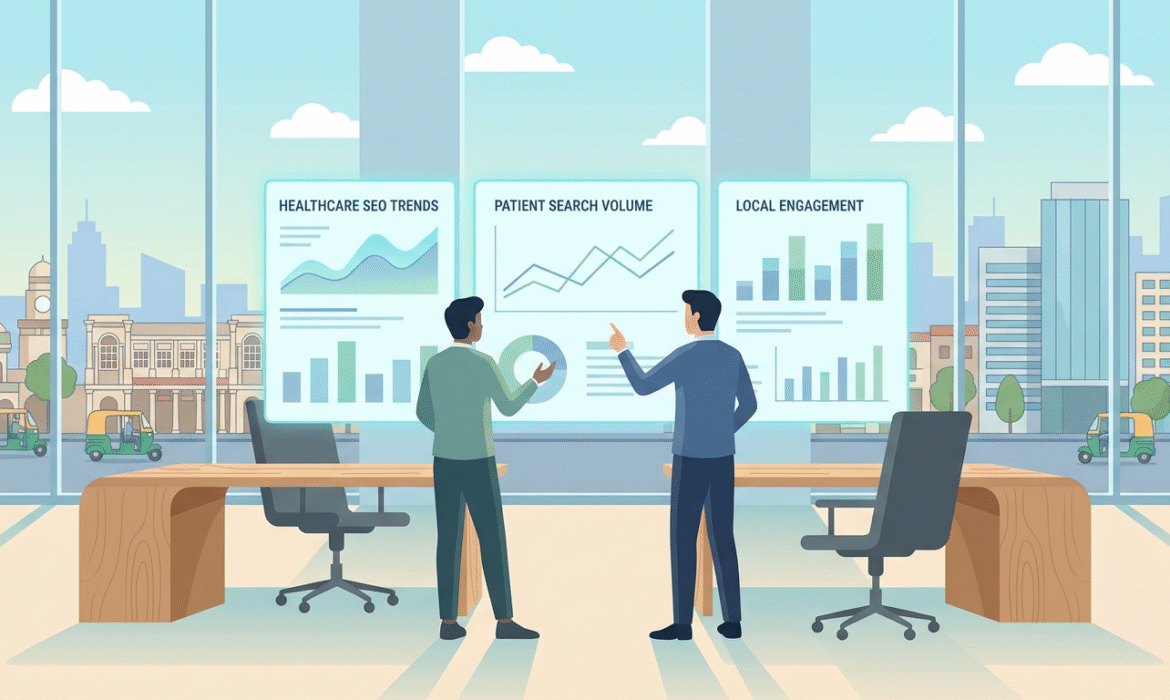
Your practice offers excellent care. But here’s the problem: patients can’t find you online. While you’re busy treating patients, your competitors dominate Google search results and book appointments before anyone even knows you exist. That needs to change.
Get this: 77% of patients check search engines before booking a medical appointment. They’re searching right now for healthcare providers like you. The question is—will they find your practice or your competitor’s?
This guide shows you exactly how healthcare SEO services work in 2026 and how they’ll help you attract more patients without spending thousands on ads every month.
Let’s be real: you didn’t go to medical school to become a marketing expert. But ignoring SEO means leaving patients—and revenue—on the table.
The numbers don’t lie. 53% of all healthcare website visits come from organic search. That’s more than half your potential patient base finding providers through Google, not paid ads or social media.
Even more striking? 75% of patients only look at the first page of search results. If you’re buried on page two or three, you might as well be invisible.
Think about it this way: when someone searches “cardiologist near me” or “urgent care open now,” they’re showing clear intent. They need healthcare services immediately. Landing at the top of those searches puts you exactly where patients are looking at exactly the right moment.
Today, most patients start their search for a doctor, clinic, or hospital online rather than through referrals alone. They look for nearby providers, compare visibility and reviews, and often act on what appears first in local search results. Clickseek helps hospitals, clinics, and diagnostic centers capture this intent through local SEO, Google Business Profile optimization, and healthcare lead generation strategies — connecting providers with patients at the exact moment they’re searching, while keeping every strategy compliant and patient-first.
You can’t just slap some keywords on your website and call it done. Healthcare SEO requires specialized knowledge because you’re dealing with YMYL content—Your Money or Your Life. Google scrutinizes medical websites harder than almost any other industry.
Here’s what makes it unique:
According to SeoProfy, expert local SEO and accurate intent targeting translate directly into higher visibility for healthcare providers. But you need specialists who understand medical regulations, not just generic SEO agencies.
Healthcare is one of the few industries where trust directly shapes rankings. Google expects healthcare content to reflect real expertise and patient safety, not just keyword coverage — and Clickseek builds every healthcare strategy around that expectation. In practice, this means:
Clickseek applies this through data-driven strategies designed to strengthen online trust and patient inquiries — helping hospitals, clinics, and diagnostic centers build genuine digital credibility rather than surface-level visibility, city by city, across India.
Most of your patients live within a 10-mile radius. That’s why local SEO crushes traditional advertising for healthcare practices.
46% of all Google searches have local intent. When someone types “pediatrician near me” or “walk-in clinic downtown,” they’re ready to book an appointment—probably within 24 hours.
Your Google Business Profile is the foundation. Claim it. Optimize it. Keep it updated.
Quick wins for local healthcare SEO:
One regional hospital implemented content marketing combined with on-page local SEO and saw a 150% increase in organic traffic. Better yet, their appointment bookings jumped 87%. That’s the power of showing up when patients search locally.
Not every page carries equal weight for patient acquisition. Priority should go to:
Clickseek treats these as connected, not isolated, optimizing each to strengthen patient inquiries and online trust together — not one page in a vacuum.
Creating content just to rank is pointless if it doesn’t book appointments. Your healthcare content strategy needs to guide patients from search to scheduling.
80% of patients research medical conditions online before contacting a provider. They’re educating themselves. Your content should establish trust and position you as the obvious choice when they’re ready to book.
What works:
But remember—medical content must be accurate, authored by qualified professionals, and regularly updated. One outdated treatment recommendation can tank your credibility and your rankings.
Your website’s backend matters just as much as the content patients see.
Site speed is critical. Patients bounce if pages take more than three seconds to load. Mobile optimization isn’t optional anymore—most healthcare searches happen on smartphones, especially for urgent care and emergency services.
Schema markup helps Google understand your content structure. Use healthcare-specific schema for doctors, medical procedures, and services. It powers those rich results that include ratings, hours, and appointment booking directly in search results.
Security matters too. SSL certificates aren’t just best practice—they’re mandatory for healthcare sites handling patient information. Google prioritizes secure sites, and patients won’t trust a “not secure” warning in their browser.
Most healthcare websites don’t fail from bad care — they fail from being invisible online. The recurring mistakes Clickseek sees:
We’ve spent years understanding what makes healthcare practices succeed online. It’s not just about rankings—it’s about attracting the right patients who need your specific services.
Our approach combines technical expertise with healthcare industry knowledge. We optimize for E-E-A-T from day one, ensure HIPAA compliance in all content strategies, and focus relentlessly on local search domination where your patients actually are.
Most agencies treat healthcare clients like any other business. We don’t. Your practice deserves specialized strategies that account for medical regulations, patient behavior, and the unique challenges of healthcare marketing in 2026.
You’ve got two choices. Keep hoping patients somehow find you, or take control of your online visibility.
Start with an SEO audit of your current website. Identify technical issues, content gaps, and local SEO opportunities you’re missing. Check your Google Business Profile—is it complete, accurate, and optimized?
Then map out a content strategy addressing the questions your ideal patients are actually searching for. Build authority in your specialty with expert content that demonstrates your experience and credentials.
Ready to transform your practice’s online presence? At Clickseek Digital, we specialize in healthcare SEO services that deliver measurable results. Our team understands the unique challenges healthcare providers face and creates customized strategies that comply with industry regulations while maximizing your visibility. Contact us today at ClickSeek for a comprehensive SEO audit and discover how we can help your practice attract more patients, establish digital authority, and achieve sustainable growth in 2026 and beyond.
Healthcare SEO typically takes 6–12 months to show significant results, since Google needs time to trust medical sites where accuracy and authority matter most. Once that authority is established, rankings tend to stick and keep driving patients without ongoing ad spend.
Healthcare SEO is held to Google’s YMYL (Your Money or Your Life) standards, meaning stricter E-E-A-T requirements and HIPAA compliance considerations. Medical credentials must be clearly displayed, and content accuracy standards are higher since they can affect patient health decisions.
Costs vary based on practice size, competition, and goals, so there’s no single fixed number. That said, ROI typically outperforms paid advertising, since organic rankings keep generating appointments long after the initial spend.
Most patients live within a 10-mile radius of their provider, and 46% of Google searches carry local intent. When someone searches “pediatrician near me” or “urgent care open now,” they’re ready to book immediately — local SEO puts you in front of them at that moment.
Basic optimization is doable on your own, but healthcare SEO also involves medical regulations, HIPAA compliance, and E-E-A-T standards that shift with Google’s algorithm. An agency combines that technical expertise with industry knowledge to keep strategies both compliant and effective.
Site speed, mobile optimization, and healthcare-specific schema markup are critical, since slow pages cause patients to bounce. SSL security is also mandatory for sites handling patient information.
Condition-specific guides, FAQ pages, and service pages matching real patient search intent work best. Content must stay accurate and current, since outdated information hurts both credibility and rankings.
It’s the foundation of local healthcare SEO, often the first thing patients see. Accurate hours, services, and active review management directly affect whether patients choose your practice.
Clickseek combines technical SEO expertise with healthcare industry knowledge, optimizing for E-E-A-T and HIPAA compliance from day one. The focus stays on local search domination and attracting the right patients.
Healthcare falls under Google’s YMYL (Your Money or Your Life) standards, so inaccurate content can affect patient decisions and site trust. Content must be authored or reviewed by qualified professionals to meet Google’s accuracy bar.

Bangalore, India
