
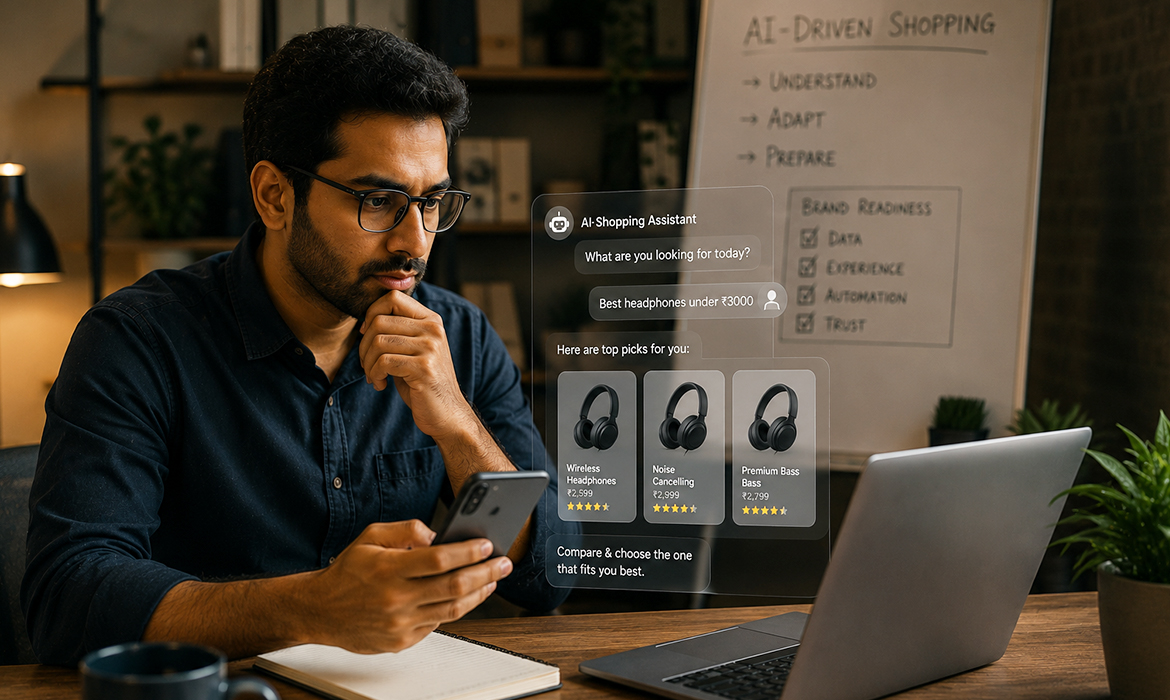
Agentic commerce is already operational in 2026. AI agents now complete purchases autonomously, bypassing traditional shopping funnels entirely. If your brand lacks agent discoverability infrastructure, you’re excluded from these transactions before they begin. This shift demands immediate preparation—not future planning. Here’s what agentic commerce means for your business, what systems are live today, and how to make your brand agent-ready now.
AI-assisted shopping suggests products. Agentic commerce completes purchases. The difference? Autonomy. An agentic system receives intent (“find running shoes under ₹5000”), queries structured product data, compares options across merchants, and executes checkout—no human clicks required.
Traditional ecommerce relies on users browsing pages. Agentic commerce skips the website entirely. Agents parse intent, query APIs for structured product data (pricing, inventory, delivery terms), compare options, and transact—all through machine-readable protocols. The browse-and-click funnel becomes query-and-execute.
OpenAI launched its Agentic Commerce Protocol (ACP) in early 2025, enabling ChatGPT to complete purchases directly within conversations. Users set preferences, and the agent handles product discovery through checkout.
Google’s Action Protocol 2 (AP2) allows Assistant to transact across participating merchants. Announced in late 2025, AP2 standardizes how agents access catalog data, pricing, and checkout APIs—creating a unified commerce layer.
Microsoft integrated Copilot Checkout in Windows 11, while Shopify rolled out Agentic Storefronts—API-first commerce infrastructure designed for agent access. Both went live Q4 2025. This isn’t speculative. It’s operational.
When agents bypass your website, CTR loses meaning. Users never click. Agents query, compare, and transact through APIs.
What matters now: how often agents return your products in response to queries. If your brand appears in agent recommendations and gets selected for purchase, you’re winning. If not, you’re invisible. Learn how structured data drives both ecommerce SEO and agent discoverability.
No recommendation = no sale. Agent-driven commerce is zero-sum at the query level. Brands that aren’t machine-readable simply don’t exist in this channel.
Agents need clean, structured data. Product schema, enriched attributes, and standardized feeds make your catalog queryable. Messy data = invisible brand.
Agents cross-reference data. Inconsistent pricing or stock info across platforms triggers distrust flags. Consistency builds agent confidence.
Agents evaluate post-purchase risk. Structured, machine-readable return policies improve your selection probability. Ambiguity kills conversions.
Review your catalog. Ensure every product has complete attributes, accurate pricing, and proper schema markup. This is foundational.
Check if your platform (Shopify, WooCommerce, custom stack) supports emerging agentic protocols. If not, plan migration or API integration.
Eliminate discrepancies. Agents flag inconsistencies. Unified data across your website, feeds, and APIs is non-negotiable.
Tag agent-initiated sessions differently. Measure conversion rates, basket size, and return rates for AI-driven purchases separately from human traffic.
Agentic commerce requires active management. Designate someone to maintain data freshness, monitor agent query patterns, and adjust based on performance.
Highest urgency. DTC brands compete directly in agent queries. Structured data and API readiness are immediate priorities.
Ensure consistency across all channels. Agents aggregate data from multiple sources—inconsistencies hurt selection rates.
Clickseek Digital approaches agentic commerce through proven technical foundations rather than unverifiable claims. We’re applying our established technical SEO and structured-data capabilities—core elements of our ecommerce SEO package—to this emerging discoverability channel. The underlying principle remains consistent: ensuring product data is machine-readable and accessible. What’s shifting is how AI agents consume and act on that data, and we’re adapting our methodologies accordingly while maintaining the same rigorous standards that drive measurable results.
Our approach involves reviewing schema markup completeness, product feed quality, and pricing/stock consistency across channels—the same technical groundwork already part of our ecommerce marketing services. We’re explicitly reframing this work for agent-readability rather than positioning it as a separate, new service line.
We’re treating agentic readiness as a natural extension of ecommerce SEO work clients may already have—not as a separately-priced “agentic commerce audit” service. This reinforces the overlap between traditional SEO and agent discoverability while avoiding the vendor-urgency pattern flooding the market.
Agentic commerce is when AI agents autonomously research, compare, and complete purchases on behalf of users—without human browsing or clicking.
It’s live. OpenAI’s ACP, Google’s AP2, Microsoft Copilot Checkout, and Shopify’s Agentic Storefronts all launched in 2025 and are operational in 2026.
Extend it. Traditional SEO and agentic readiness share structured data foundations, but agents require transactional APIs and consistent cross-channel data.
Chatbots suggest. Agentic systems execute. Agentic commerce completes the entire purchase flow autonomously, from query to checkout, without human intervention.

Bangalore, India
